Our multichannel family is growing. Following 8xOUT and 8xIN+8xOUT, meet RASPIAUDIO 8xOUT STUDIO: a new board focused on studio connections and high-quality multichannel playback.
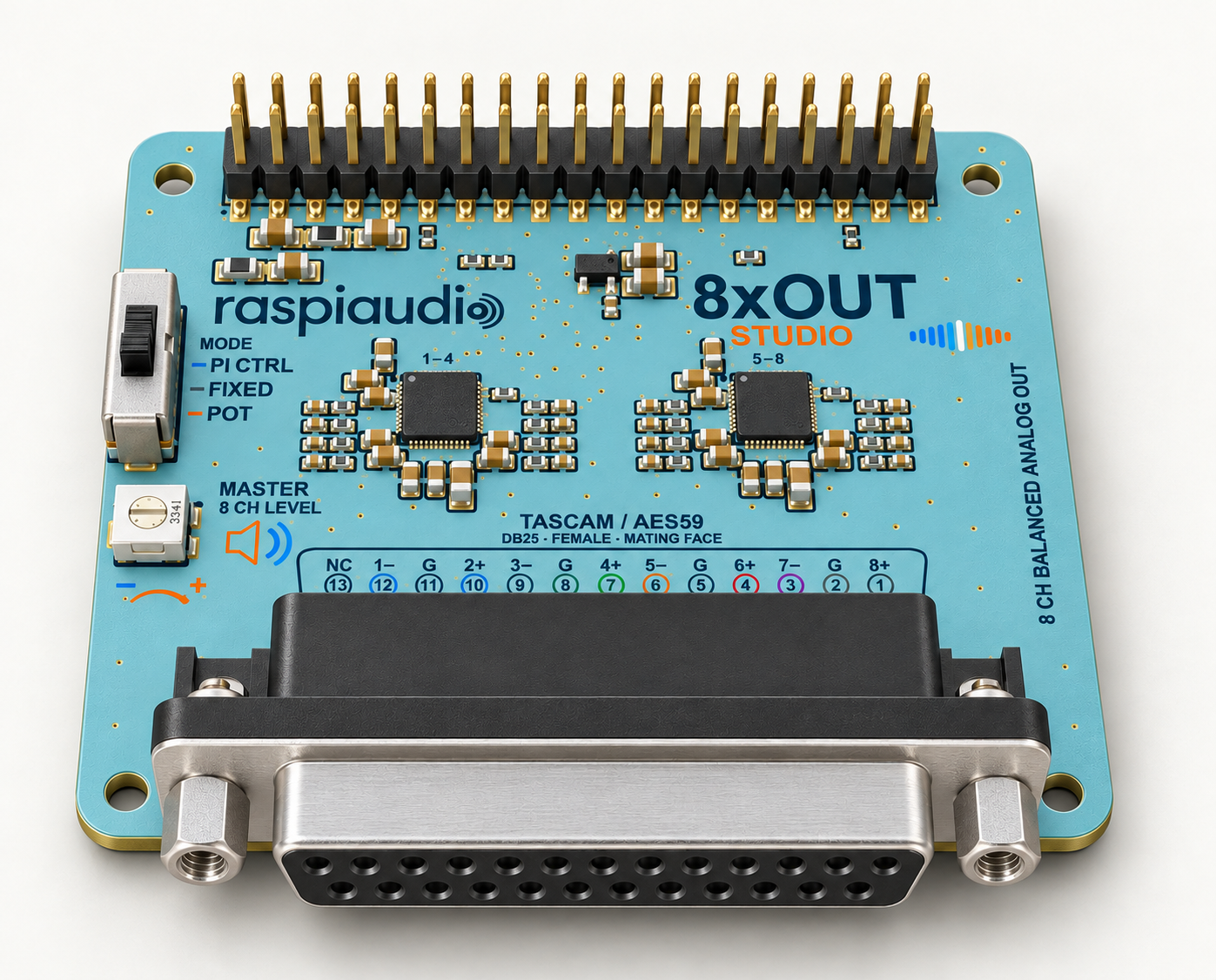
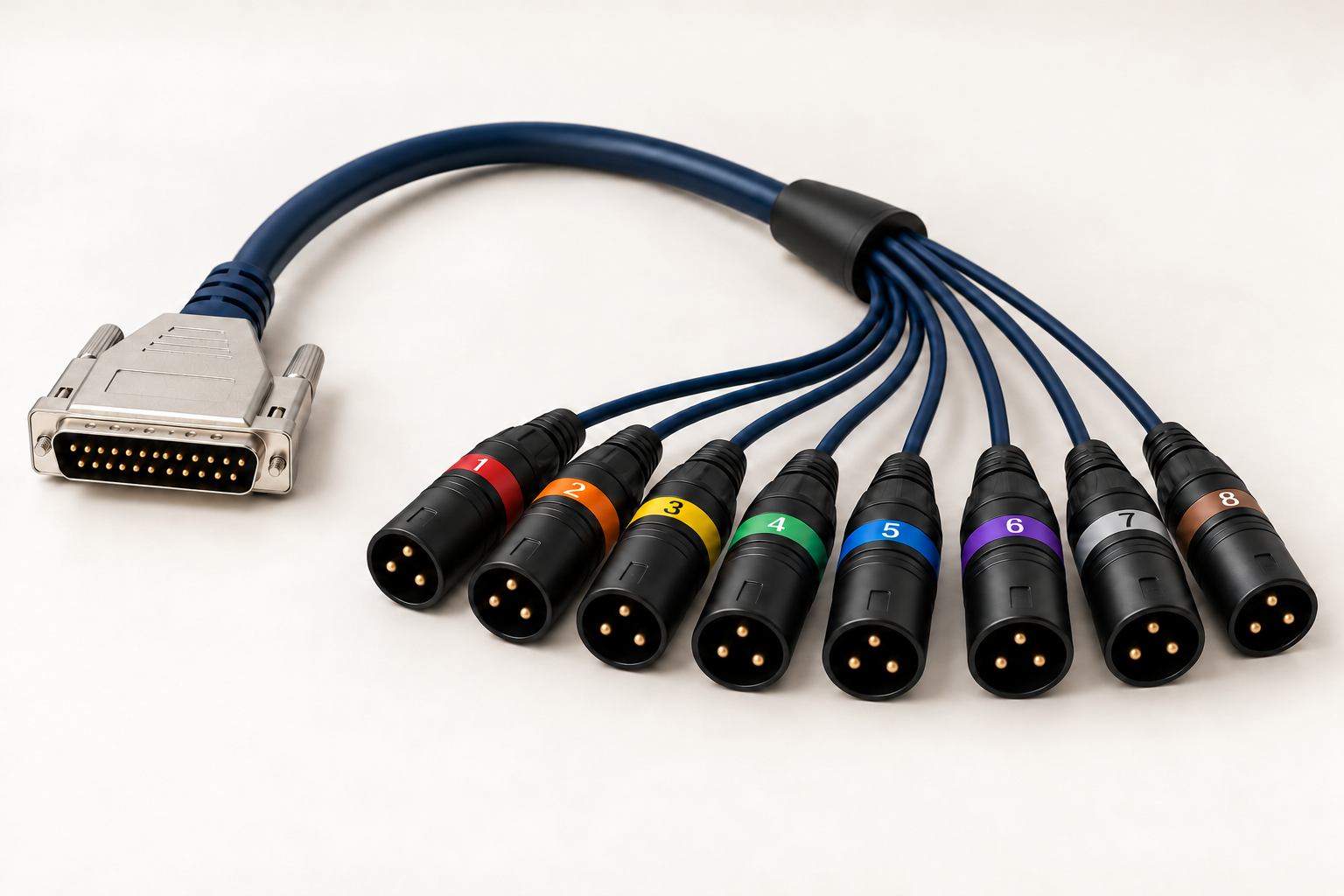
One DB25. Eight balanced XLR outputs. Illustrative cable example. Cable not included.
Eight balanced outputs. One DB25.
Connect your Raspberry Pi 5 to active monitors, power amplifiers or studio equipment through eight independent balanced analogue line outputs, carried on a DB25 connector with the TASCAM / AES59 analogue pinout.
Choose a matching breakout cable with eight male XLR connectors or eight 1/4-inch (6.35 mm) TRS jacks to suit your equipment. Breakout cables are not included. This is an output board, not an input interface or a speaker power amplifier.
Output impedance: approximately 600 ohms per balanced output.
Dual ESS SABRE conversion
Two ESS SABRE ES9081Q DACs, each handling four differential channels, deliver a dedicated conversion stage for all eight balanced outputs.
- 124 dB dynamic range (DNR), A-weighted.
- -110 dB THD+N.
These are typical ESS DAC specifications in four-channel differential mode, not measurements of the complete board.
The analogue stages also benefit from two dedicated ESS SABRE ultra-low-noise power regulators: a carefully designed low-noise power foundation to support the DACs’ dynamic-range potential.
DAC capability: up to 32-bit / 768 kHz.*
Current Raspberry Pi configurations are generally limited to up to 32-bit / 192 kHz by the software and hardware path. Actual eight-channel formats and rates depend on the OS, driver, clocks and application. A tested rate matrix will follow; 192 kHz is not a guarantee for every configuration.
Plug-and-play on Raspberry Pi OS
Fit the board to the Pi 5’s 40-pin header with the power off, then boot Raspberry Pi OS. Automatic recognition and eight-channel playback have been tested, with no extra board driver to install. The onboard microcontroller handles DAC initialization.
Use it with CamillaDSP for active crossovers, EQ, room correction and channel routing, or with other Raspberry Pi audio software supporting eight-channel ALSA playback. Install and configure your chosen application, select the outputs and start building your audio setup.
Powered directly by your Raspberry Pi. USB ports stay free. Audio and power use the 40-pin header, so no separate power supply is needed for the audio board. Use an appropriately sized power supply for your complete Pi 5 system and peripherals.
Three positions. Your choice of level control.
The onboard selector offers three control modes, arranged vertically as on the board:
- PI CTRL: send commands from the Raspberry Pi to control attenuation directly in both DACs. ALSA or application integration is separate; this does not mean a volume slider automatically appears in every Linux mixer.
- FIXED: keep both DACs at 0 dB digital attenuation and manage listening volume elsewhere in your system. Start with the downstream volume turned down.
- POT: turn the small onboard screwdriver-adjustable trimmer to set the master level directly in both DACs through their digital attenuation controls. All eight channels change together, without adjusting each output separately.
Control functions are planned for the release firmware; availability depends on the final firmware and supported Pi configuration. Explore the three-position selector.
Low latency, with more tests to come
Our initial measurement is 0.58 ms at 48 kHz. More tests and measurement conditions will follow. Latency depends on the software, buffering and signal path as well as the board; this is not a universal end-to-end latency guarantee.
What can you build?
- Home cinema: eight independent outputs for a 7.1-channel playback setup, with decoding and routing handled by your Pi software.
- Studio: eight balanced playback channels for active monitors, amplifiers or other line-level equipment.
- Active speakers with CamillaDSP: two four-way speakers, or one eight-way system, with one filtered output per amplifier channel.
- Multi-zone audio: four stereo pairs or eight mono zones, using your choice of routing software.
These are software configuration examples, not onboard DSP functions. External amplification or active speakers are required.
A limited first batch is open for preorder
We have already placed the production orders and are opening a small initial preorder batch. We are targeting availability within one month, with estimated dispatch from 16 November 2026, following final production and software checks. This is a preorder, not immediate shipping.
Preorder price: EUR 89.90, instead of EUR 109.90.
Explore 8xOUT STUDIO, board views and cable examples
What would you build with eight balanced outputs: a multichannel studio setup, an active speaker system, or something else? Tell us about your project!